AUPWIT Wraps Up ALUMINIUM 2026 in Düsseldorf
13 October, 2026


If you are in the metal recycling or machining business, you have probably faced this question at some point. Should you go with a vertical briquetting machine or a horizontal one? Both do the same basic job: turning loose metal chips, turnings, and filings into dense, compact briquettes that are easier to store, transport, and sell. But the way they go about it, and the kind of operation they suit best, are quite different.
This guide breaks down the key differences between vertical and horizontal briquetting machines. We will look at how each type works, what they are good at, where they fall short, and what you should consider when making a choice. By the end, you should have a clearer picture of which configuration fits your shop floor, your production volume, and your budget.

A vertical briquetting machine uses a downward pressing motion to compact metal chips into dense briquettes. Material feeds in from the top, usually through a hopper, and gravity helps pull the chips down into the compression chamber. A hydraulic ram then applies pressure from above, forcing the material into a mold that shapes it into a cylindrical briquette.
The vertical configuration is typically built around a four-column structure. The main cylinder, punch, and die are arranged vertically, which gives the machine its compact footprint. This design is widely used today because it offers a good balance of power and practicality.
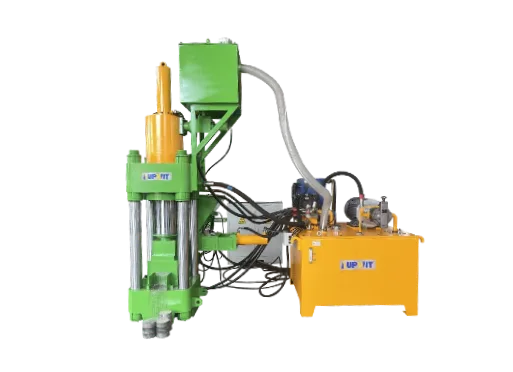
Vertical machines are typically better suited to small and medium production volumes. While they can handle a wide range of materials, their throughput is generally lower than that of a horizontal machine. That said, modern vertical models are available in large tonnages and can achieve substantial output.
Now let us look at the other side of the equation. A horizontal briquetting machine compresses material using a sideways, or lateral, pressing action. The machine is fed from above via a hopper, and the material drops into a pre-compression chamber. From there, a charge cylinder pushes the chips into the main compression chamber, where a horizontal ram applies the pressing force.
Horizontal machines often have a larger physical footprint and can be equipped with conveying systems for integration into fully automated production lines.
To make the differences easier to grasp at a glance, here is a summary of the key comparison points.
| Comparison Dimension | Vertical Briquetting Machine | Horizontal Briquetting Machine |
|---|---|---|
| Pressing direction | Downward (gravity-assisted) | Lateral (sideways) |
| Footprint | Compact, smaller floor space | Larger, requires more space |
| Typical structure | Four columns | Three or four columns optional |
| Production capacity | Low to medium output | High, continuous output |
| Best suited for | Small to medium-sized operations, limited space | Large-scale recycling lines, high volume |
| Operation | Simpler, easier to monitor | Slightly more complex |
| Maintenance | Cleaner structure, easier to maintain | More complex design, higher maintenance needs |
| Material handling | Smooth vertical flow, less clogging | Handles oily, wet, and viscous scraps well |
The choice between vertical and horizontal briquetting machines depends on four main factors: your production volume, available floor space, material type, and maintenance capacity. With the key differences laid out, let us now turn to the practical question of how to apply these criteria to your specific situation.
This is usually where you should start. If your operation generates a relatively modest amount of metal chips, a vertical machine will likely meet your needs without taking up unnecessary space. For large-scale operations that run continuously and process high volumes, a horizontal machine is generally the better fit.
Space is often a deciding factor. Vertical machines are designed to be compact, making them ideal for workshops where every square meter counts. Horizontal machines, by contrast, need more room for installation and operation.
Both configurations can handle a wide range of metals, including steel, cast iron, aluminum, and copper chips. However, if your material is particularly oily, wet, or viscous, a horizontal machine may have an edge, as it is often designed with these conditions in mind. For standard dry or lightly oiled chips, either type will do the job well.
If you have a small team and want to keep maintenance simple, the vertical design offers clear advantages: a cleaner structure, easier cleaning, and fewer moving parts to service. Horizontal machines, while powerful, require more attention and are more complex to maintain.
Modern briquetting machines, whether vertical or horizontal, can be equipped with PLC control systems for automated feeding, compression, and briquette ejection. Both types can also be integrated into fully automated production lines with conveying systems. If full automation is a priority, check whether your chosen model supports the level of integration you need.
H2: Aupwit Vertical Briquetting Press Solutions
Now that we have covered the general landscape, let us talk about what we offer at Aupwit. We have been manufacturing hydraulic equipment since 2008, with a focus on briquetting presses, metal balers, shredders, and shears. Our Y83 series vertical briquetting press is designed specifically for metal chip recycling applications.
| Model | Briquette diameter | Motor | Oil pump |
| Y83-160Z | φ100mm | 18.5KW-4 | HY63 |
| Y83-160ALZ | φ110mm | 18.5KW-4 | HY63 |
| Y83-250Z | φ100mm | 22KW-4 | HY100 |
| Y83-250ALZ | φ120mm | 22KW-4 | HY100 |
| Y83-315Z | φ110mm | 30KW-4 | HY160 |
| Y83-315ALZ | φ130mm | 30KW-4 | HY160 |
| Y83-400Z | φ120mm | 37KW-4 | HY180 |
| Y83-400ALZ | φ140mm | 37KW-4 | HY180 |
| Y83-500Z | φ140mm | 45KW-4 | HY250 |
| Y83-500ALZ | φ160mm | 45KW-4 | HY250 |
| Y83-630Z | φ180mm | 2*37KW-4 | 2*HY180 |
| Y83-630WZ | φ180mm | 2*37KW-4 | 2*HY180 |
| Y83-800Z | φ220mm | 3*45KW-4 | 3*HY250 |
| Y83-800WZ | φ220mm | 3*45KW-4 | 3*HY250 |
| Y83-1000Z | φ250mm | 4*45KW-4 | 4*HY250 |
| Y83-1000WZ | φ250mm | 4*45KW-4 | 4*HY250 |
| Y83-1250Z | φ300mm | 2*132KW-4 | 4*A4V250 |
| Y83-1250WZ | φ300mm | 2*132KW-4 | 4*A4V250 |
The Y83 series produces briquettes weighing 3 to 6 kg each, in cylindrical block shapes that are easy to transport and ready for furnace charging. The machine is suitable for aluminum alloy plants, steel casting plants, aluminum casting plants, and copper casting plants.
So, where does that leave us? Choosing between a vertical and a horizontal briquetting machine ultimately comes down to your specific operational needs.
If you have limited floor space, moderate production volumes, and want a machine that is simpler to operate and maintain, a vertical briquetting press is a strong choice. It delivers high-density briquettes, recovers cutting fluids effectively, and fits neatly into most workshop layouts.
If you are running a large-scale operation with continuous high-volume throughput, and you have the space to accommodate a larger machine, a horizontal briquetting press offers the production capacity you need. It handles oily and wet materials well and can be integrated into fully automated production lines.
Both configurations have their place in the metal recycling industry. The right one for you is the one that matches your production volume, your available space, and your maintenance capabilities.
Aupwit has been a professional hydraulic machinery manufacturer since 2008, offering vertical briquetting presses, single-output and double-output models, to meet diverse customer needs. Whether you are processing steel, cast iron, aluminum, or copper chips, we can help you find the right solution for your operation. Contact us to discuss your specific requirements; we will recommend the most practical equipment for your shop floor.


This website uses cookies to improve your experience while you navigate through the website. Out of these, the cookies that are categorized as necessary are stored on your browser as they are essential for the working of basic functionalities of the website.
We also use third-party cookies that help us analyze and understand how you use this website. These cookies will be stored in your browser only with your consent. You also have the option to opt-out of these cookies. But opting out of some of these cookies may affect your browsing experience.