AUPWIT Wraps Up ALUMINIUM 2026 in Düsseldorf
13 October, 2026


If you are shopping for a briquetting press, one of the first decisions you will face is whether to go with a hydraulic or a mechanical machine. Both technologies do the same basic job: turning loose metal chips, turnings, and scrap into dense, compact briquettes that are easier to store, transport, and recycle. But the way each type achieves that result, and the kind of operation each one suits best, are quite different.
This guide breaks down the key differences between hydraulic and mechanical briquetting presses. We will look at how each type works, compare their performance characteristics, and walk through the practical factors you should consider when making a choice. By the end, you should have a clear picture of which technology fits your production volume, your material type, and your shop floor.
A hydraulic briquette press is driven by an electric motor via a high-pressure hydraulic oil system. The motor powers a hydraulic pump, which generates pressurized oil that pushes a piston to compress the material. This works much like a mechanical piston press, but instead of mechanical linkages, the energy travels through hydraulic fluid.
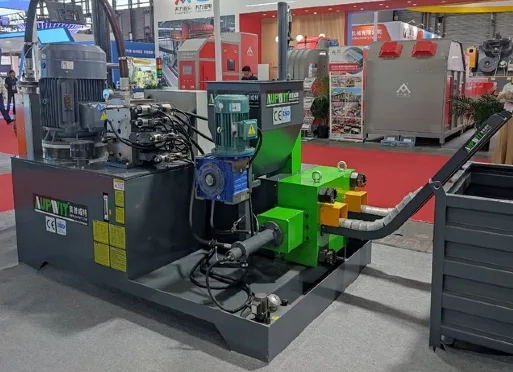
A key feature of the hydraulic design is that the forces stay contained within the press cylinder, rather than being transmitted through the machine frame. This allows the machine to be built in a relatively compact and light configuration.
The pressing cycle is typically controlled by a programmable system that you can adjust depending on the input material and the desired product quality. One trade-off, however, is speed. Hydraulic systems operate at a noticeably slower cycle speed than mechanical ones, which results in lower outputs. Production capacities for hydraulic presses generally range from 50 to 400 kg/h.
Now let us turn to the mechanical side. A mechanical briquette press, also called a stamping or punching press, uses a motor-driven flywheel and eccentric mechanism to move a reciprocating piston. The distinctive feature is its pair of flywheels, which are spun by the motor via belts. These flywheels store kinetic energy and release it in short, powerful bursts to drive the piston through the compression stroke.
Material feeds into a compression chamber through a hopper, often via an auger conveyor. A reciprocating piston then pressurizes the fed material, forcing it through a conical die to form briquettes. Since the mechanical system does not rely on hydraulic fluid to transmit power, it has fewer hydraulic components and overall lower system complexity.
Mechanical presses are known for their high-speed operation and are well-suited for large-scale, continuous production. Production capacities for mechanical piston presses typically range from 250 to 1,500 kg/h.
To make the differences easier to grasp at a glance, here is a summary of the key comparison points.
| Comparison Dimension | Hydraulic Briquette Press | Mechanical Briquette Press |
|---|---|---|
| Drive mechanism | Motor → hydraulic pump → oil → piston | Motor → flywheel → eccentric → piston |
| Pressing pressure | Lower; normally limited to about 30 MPa | Higher; can achieve greater compaction force |
| Briquette density | Lower; typically below 1,000 kg/m³ | Higher; briquettes are denser and harder |
| Production capacity | Lower; typically 50-400 kg/h | Higher; typically 250-1,500 kg/h |
| Moisture tolerance | Higher; can handle 15% to 35% moisture | Lower; requires drier feedstock |
| Machine footprint | More compact and light | Larger and heavier |
| Noise and vibration | Lower | Higher |
| Pressure control | Adjustable pressure for different materials | Fixed or limited adjustment |
| Maintenance | Periodic fluid checks; less mechanical wear | Fewer hydraulic parts; may need more frequent roller changes |
| Initial cost | Generally lower upfront | Higher upfront |
The choice between hydraulic and mechanical briquetting presses depends on four main factors: your production volume, material characteristics, maintenance capacity, and budget. With the differences laid out, let us now get practical and walk through each factor in turn.
This is usually the first thing to look at. If your operation generates a relatively modest amount of metal chips, a hydraulic press will likely meet your needs without over-investing in capacity. The real draw is the ability to operate at lower output levels. For large-scale operations that run continuously and process high volumes, a mechanical press is generally the better fit.
Hydraulic presses are more forgiving when it comes to moisture. They can tolerate somewhat higher moisture contents than mechanical presses; some manufacturers quote figures between 15% and 35%. This makes them a good choice when your feedstock is not perfectly dry. Mechanical presses, by contrast, require drier material and are more sensitive to variation.
Hydraulic systems require periodic fluid checks but experience less mechanical wear. Mechanical presses have fewer hydraulic components, which reduces complexity, but may need more frequent replacement of wear parts like rollers. If you have a small maintenance team, the hydraulic design may offer a lower overall maintenance burden.
Hydraulic presses generally have a lower initial cost, making them more accessible for smaller operations. Mechanical presses typically require a higher upfront investment but may offer long-term advantages in high-volume, continuous production scenarios.
Here is a point worth noting: briquettes from mechanical presses are generally denser and harder than those from hydraulic ones. If your application demands maximum density and durability, a mechanical press may be the better choice. For standard recycling applications where moderate density is acceptable, a hydraulic press will do the job well.
Hydraulic presses are a strong choice for metal recycling because they offer a compelling combination of versatility, affordability, and ease of operation. Let us walk through why.
Hydraulic presses can handle a wide range of metal chips, including aluminum, steel, copper, cast iron, and more. Their ability to tolerate variation in moisture and oil content makes them particularly well-suited for processing the oily, coolant-soaked swarf that comes straight off a machining center.
The lower noise and vibration levels are another advantage. This makes hydraulic presses a better fit for shop floor environments where operator comfort and workplace noise regulations are considerations.
The adjustable pressure settings give you flexibility. You can adapt the machine to different material densities, which is helpful when processing mixed or variable feedstocks.
Maintenance is also more straightforward. The hydraulic design tends to have fewer mechanical wear points, which translates to simpler routine servicing and lower long-term maintenance requirements.
Now that we have covered the general technology comparison, let us talk about what we offer at Aupwit. We have been manufacturing hydraulic equipment since 2008, with a focus on briquetting presses, metal balers, shredders, and shears. Our product lineup includes three main hydraulic briquetting press configurations.
This is our standard hydraulic briquetting solution for small to medium production volumes. It is designed for operations that need a reliable, straightforward machine without unnecessary complexity.
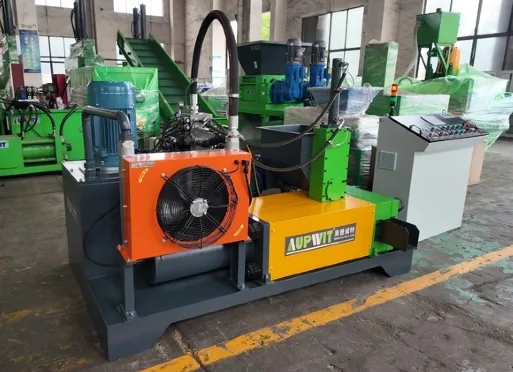
For operations that need higher throughput without stepping up to a mechanical press, our double output model offers increased efficiency. It processes more material per cycle while maintaining the same hydraulic advantages: lower noise, adjustable pressure, and forgiving material handling.
Our vertical briquetting press is designed specifically for metal chip recycling applications. The vertical configuration offers a compact footprint that fits easily into workshops with limited floor space. After pressing, iron chip density reaches 5 to 6 tonnes per cubic meter. For copper and brass materials, density can exceed 7 tonnes per cubic meter. The machine is suitable for aluminum alloy plants, steel casting plants, aluminum casting plants, and copper casting plants
For operations looking beyond standalone machines, integrated metal chip processing systems combine shredding, briquetting, and fluid recovery into a single automated production line.
So, what does that mean for your decision? Choosing between a hydraulic and a mechanical briquetting press ultimately comes down to your specific operational needs.
If you have moderate production volumes, variable feedstocks, limited floor space, and want a machine that is simpler to operate and maintain, a hydraulic briquetting press is a strong choice. It delivers consistent briquettes, handles oily and moist materials well, and fits neatly into most workshop layouts.
If you are running a large-scale operation with continuous high-volume throughput and you need maximum briquette density, a mechanical press offers the production capacity and compaction force you require.
Both types have their place in the metal recycling industry. The right one for you is the one that matches your production volume, your material type, your available space, and your maintenance capabilities.
Aupwit has been a professional hydraulic machinery manufacturer since 2008, offering single output, double output, and vertical briquetting presses to meet diverse customer needs. Whether you are processing steel, cast iron, aluminum, or copper chips, we can help you find the right solution for your operation. Contact us to discuss your specific requirements; we will recommend the most practical equipment for your shop floor.


This website uses cookies to improve your experience while you navigate through the website. Out of these, the cookies that are categorized as necessary are stored on your browser as they are essential for the working of basic functionalities of the website.
We also use third-party cookies that help us analyze and understand how you use this website. These cookies will be stored in your browser only with your consent. You also have the option to opt-out of these cookies. But opting out of some of these cookies may affect your browsing experience.